

How To Repair Dna Damage Naturally
The right way to repair Deoxyribonucleic acid
Salk scientists discover that a microprotein helps cells choose all-time path to repair genes and avoid cancer
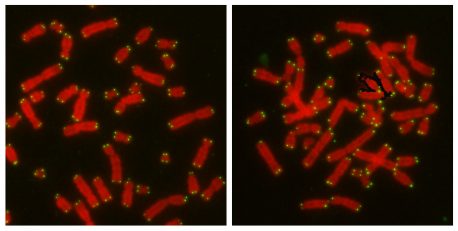
Click here for a high-resolution image
Credit: Salk Institute
LA JOLLA—Is it better to do a task chop-chop and make mistakes, or to do it slowly merely perfectly? When it comes to deciding how to fix breaks in Dna, cells face up the same pick between two major repair pathways. The determination matters, because the wrong choice could cause even more Deoxyribonucleic acid damage and lead to cancer.
Salk Plant scientists found that a tiny protein chosen CYREN helps cells choose the correct pathway at the right fourth dimension, clarifying a longstanding mystery most DNA repair and offering researchers a powerful tool that could guide better treatments for cancer. The work appears in Nature on September 20, 2022.
"Elucidating DNA repair pathways is critical to understanding how they can sometimes exist toxic," says Jan Karlseder, a professor in Salk's Molecular and Cell Biology Laboratory and the senior writer of the new paper. "Our discovery of CYREN'due south function non only adds to our torso of cognition, it gives us a new tool with which to potentially fight cancer."

Click here for a high-resolution prototype
Credit: Salk Institute
Double-strand breaks, the most serious injuries that happen to DNA, can be repaired past ane of ii pathways: a fast but error-decumbent process known every bit NHEJ (non-homologous cease joining) and a slower, error-free pathway known as Hr (homologous recombination). The faster pathway efficiently rejoins cleaved strands, but in the case of multiple breaks it tin can join the incorrect two ends together, making things much worse for a cell. The slower pathway is error-free considering it relies on having an undamaged Deoxyribonucleic acid sequence to guide the repair, but this means it tin only operate after a cell has copied its genetic data in society to split up. Given that, the fast pathway operates exclusively before DNA is copied, though its machinery is and then efficient and prolific that scientists have wondered why it doesn't outcompete the slower, more-exact pathway subsequently copying, too. Scientists accept long suspected that something must be holding the faster option dorsum in those cases.
That something, the new work reveals, is a microprotein called CYREN, which inhibits the faster pathway when a Deoxyribonucleic acid copy is available for the slower pathway to use. CYREN was discovered by another Salk scientist, Alan Saghatelian, as part of a 2022 effort to identify small proteins called "brusque ORF-encoded peptides" or SEPs, which are increasingly being plant to have critical biological roles.
"We found a lot of these peptides in our before study but nosotros didn't really know if any of them were of import until the Karlseder lab got involved," says Saghatelian, a professor in the Clayton Foundation Laboratories for Peptide Biology and one of the newspaper's coauthors. "Cheers to this impressive new work, we at present know there are some really important molecules amidst the hundreds we're discovering."
Saghatelian'due south research had suggested that CYREN was interacting with the chief switch of the faster pathway, a protein called Ku. To determine the exact nature of the interaction, Karlseder's team worked with a region of the genome where repair is ordinarily suppressed to prevent dangerous fusions: the ends of chromosomes, called telomeres. Researchers tin artificially disturb telomeres to actuate the fast pathway, making it a model system to test CYREN's furnishings.
Click hither for a high-resolution prototype
Credit: Salk Institute
"Telomeres offer a nifty inquiry tool because they actually need to repress repair, just at that place are ways to activate the repair machinery so that you lot can written report it in a very controlled fashion," says Nausica Arnoult, a Salk research acquaintance and beginning writer of the paper. The Salk team did so, and found that with CYREN nowadays, no repairs occurred subsequently the jail cell copies its DNA, suggesting that information technology does flip off the master switch, Ku. Without CYREN effectually, Ku's fast pathway was active both earlier Dna was copied and later on.
Because the telomere experiments did non tell the team much about the competition betwixt the fast and slow pathways, Arnoult adjacent used molecular tools to compare repair in living cells with and without CYREN. She combined the Deoxyribonucleic acid pair of scissors known equally CRISPR with genes for fluorescent proteins that would be triggered past repair and so that she could cut Dna in specific ways and see from the ensuing colour which pathway had made the repair. She also analyzed all the poly peptide interactions that took place.
These experiments revealed that CYREN directly attaches to Ku to inhibit the fast pathway both depending on timing (before or after Dna copying) and the type of DNA break (polish versus jagged, for instance). Its action tin even tune the ratio of fast to dull repairs.
"Our report shows that CYREN is an important regulator of Dna-repair-pathway choice," says Karlseder, who holds the Donald and Darlene Shiley Chair at Salk. "The work besides points to the heady possibility of potentially introducing Deoxyribonucleic acid harm in cancer cells and using CYREN to prevent them from making repairs."
Other authors included: Adriana Correia, Jiao Ma and Anna Merlo of Salk; Sara Garcia-Gomez, Marija Maric and Simon J. Boulton of the Francis Crick Institute; Marco Tognetti of ETH Zurich; and Christopher W. Benner of University of California San Diego.
The work was funded by: the Homo Frontiers Science Programme, the Paul F. Glenn Center for Biological science of Aging Enquiry, a Larry Hillblom Foundation Fellowship Grant, a Wellcome Trust Senior Investigator Award, the Francis Crick Institute (Cancer Inquiry UK), the UK Medical Research Council, the Wellcome Trust, the National Institutes of Wellness, the National Cancer Institute, The Leona M. and Harry B. Helmsley Charitable Trust, Dr. Frederick Paulsen Chair/Ferring Pharmaceuticals, a Salk Establish Cancer Middle Core Grant, the Donald and Darlene Shiley Chair, the Highland Street Foundation, the Fritz B. Burns Foundation and the Emerald Foundation.
Source: https://www.salk.edu/news-release/right-way-repair-dna/
0 Response to "How To Repair Dna Damage Naturally"
Post a Comment